The Modern Equine Vet
January 2026
Vol 16 Issue 1 2026
Click Here to View Issue
Equine Model Points to Benefit of Metformin for Afib
By Adam Marcus
If the drug metformin proves to be a useful treatment for atrial fibrillation in people, thank a horse.
New findings from researchers in Denmark suggest that the diabetes drug, which reduces glucose production in the liver and increases cells’ sensitivity to insulin, may also protect the heart against prolonged atrial fibrillation (Afib).
“Our study shows that metformin, when given before Afib induction, protects against key features of Afib-induced remodeling,” said Simon Libak Haugaard, PhD, an assistant professor in translational cardiology with the Equine Cardiac Group at the University of Copenhagen, who helped lead the work.
A horse’s heart may be a dozen times larger than that of its human rider, but in at least 1 key respect, the equine and hominid pumps are remarkably similar. Both hearts are prone to the spontaneous development of Afib, an arrhythmia that can lead to potentially deadly strokes in people. Horses, Dr. Haugaard said, appear not to be prone to strokes linked to Afib.
That similarity makes equine hearts an appealing model for studying human rhythm anomalies.
In addition, Dr. Haugaard said, the animals offer other advantages as models for Afib. Horses can naturally develop sustained arrhythmias that resemble those that affect humans.
Another plus: “Their size and temperament allow atrial sampling in standing, lightly sedated animals, enabling repeated, longitudinal tissue sampling. We are now expanding this to sampling all 4 cardiac chambers over time, which is unique among large-animal models. Live cardiac sampling avoids euthanizing animals at each time point.” And research into Afib in equines directly benefits the species, “which is unlike most conventional animal research,” he added.
For the new study, which appears in Circulation: Arrhythmia and Electrophysiology, Dr. Haugaard and his colleagues followed 20 horses that had implanted pacemakers to induce Afib. Half received oral metformin (30 mg/kg twice daily) starting 1 week before device implantation, and half were given placebo.
All the horses in the control group developed self-sustained Afib within 4 weeks of the intervention—about 3 times longer than in the treatment group (mean, 2.3 weeks vs 6.3 weeks, respectively), according to the researchers. Two horses that received metformin never developed the sustained arrhythmia.
Those that continued to experience the arrhythmia appeared to have a less complex form of the condition than the untreated horses. “Highly complex Afib is characterized by continuous, unbroken atrial electrical activity, whereas less complex Afib shows intermittent pauses or ‘breaks’ between activations,” Dr. Haugaard said. “Less complex Afib is typically easier to treat, whereas more complex Afib is indicative of more severe disease, where the tissue has remodeled.”
How metformin might prevent Afib is unclear, but evidence in humans indicates that the drug can improve myocardial metabolic activity, reducing oxidative stress that can trigger arrhythmias.
“The general concept that metformin improves cardiac metabolic efficiency has some human support, but direct atrial tissue–level evidence in human Afib patients is still lacking,” Dr. Haugaard said. “This is where the horse model allows us to explore such mechanisms in a way that is very difficult in people.”
Indeed, the Danish researchers found horses treated with metformin had reduced expression of genes associated with both glycolytic and oxidative phosphorylation compared with untreated controls, suggesting the drug was moderating metabolic activity.
First approved in the United States in 1994 as a treatment for high blood sugar, metformin has been experiencing something of a medicinal moment lately. Researchers have been looking at the potential benefits of the drug in conditions including cancer, cardiovascular diseases, kidney problems and even Alzheimer’s.
Translating the findings directly into the veterinary clinic—for example, giving metformin after cardioversion to prevent a recurrence of Afib—is an important next step, Dr. Haugaard said, but it requires additional evidence, particularly in horses with an already remodeled atrium. “Other important future directions include studying horses with intermittent or so-called paroxysmal Afib, where upstream metabolic modulation might be especially relevant for preventing new episodes,” he said.
Dr. Haugaard is also hoping to apply the methods from the latest work to conduct translational studies of athletes’ hearts, both human and equine. “Horse and human endurance athletes both have an increased propensity for Afib, and understanding why, and whether that risk can be mitigated, is a major focus of our group going forward,” he said. MeV
FOR MORE INFORMATION
Haugaard SL, Schneider MJ, Kjeldsen ST, et al. Metformin Protects Against Persistent Atrial Fibrillation in an Equine Model.
Circ Arrhythm Electrophysiol. 2025 Dec;18(12):e013850. doi: 10.1161/CIRCEP.125.013850.Epub 2025 Dec 2.
https://www.ahajournals.org/doi/10.1161/CIRCEP.125.013850
Larsen Ah, Jessen N, Nørrelund H, et al. A randomised, double-blind, placebo-controlled trial of metformin on myocardial efficiency in insulin-resistant chronic heart failure patients without diabetes. Eur J Heart Fail. 2020 Sep;22(9):1628-1637.
https://onlinelibrary.wiley.com/doi/10.1002/ejhf.1656

A lightly sedated horse undergoing a minimally invasive heart biopsy while standing. The biopsy instrument (B) is introduced through a catheter placed in the jugular vein in the neck and guided into the right atrium of the heart.
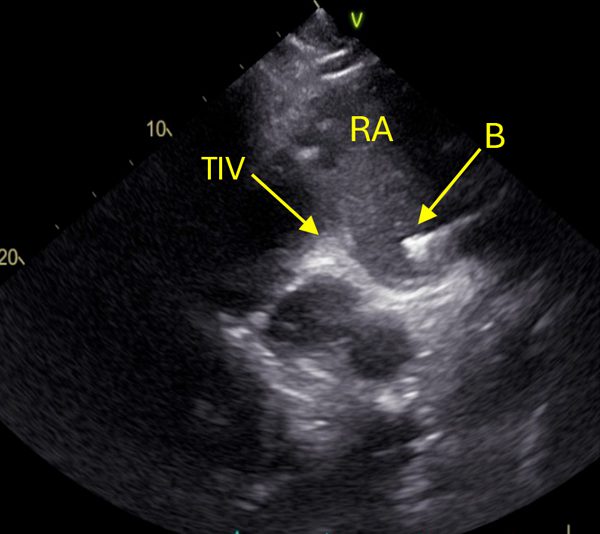
Ultrasound image showing how the biopsy is guided in real time. The opened biopsy forceps can be seen inside the right atrium (RA), positioned against the intravenous tubercle (TIV) to ensure safe and precise sampling.
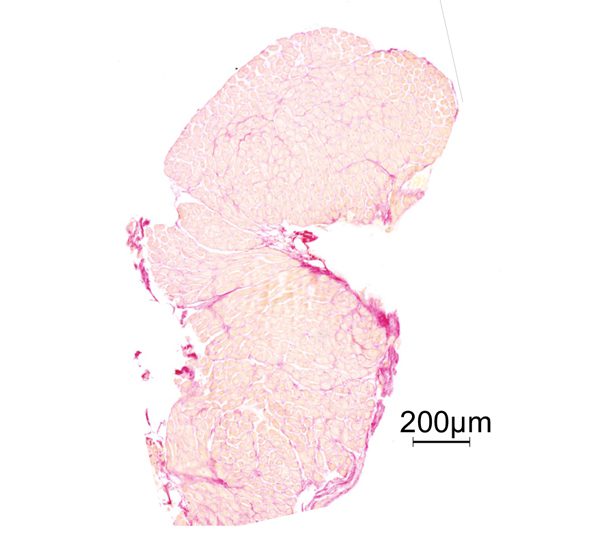
Microscopic image of an RA tissue sample obtained using this technique, Picro-Sirius Red stained to highlight the structure of the atrial muscle. The image illustrates that high-quality myocardial tissue can be obtained without the need for general anesthesia or open-chest procedures. Scale bar: 200 μm.
Source: Dr. Simon Libak Haugaard