

The Modern Equine Vet
September 2026
Vol 16 Issue 9 2026
Click Here to View Issue
Cover Story | Cardiology
Heart monitoring on the Go
By Marie Rosenthal MS
A wearable electrocardiogram for horses appears to provide several days of reliable readings, even when animals are allowed to move freely, but researchers say the technology is not quite ready for the paddock.
Researchers at the University of Minnesota studied the wearable patch, called the Cardea SOLO, in 12 horses without clinically significant arrhythmias such as atrial fibrillation. Compared with the Televet (Engel Engineering Services GmbH), considered the gold standard for ECG monitoring in equids, the patch worked well for at least the first 5 days before slippage impaired the readings.
“The exciting part was that it worked, and it did give a good quality ECG when the horse wasn’t moving around too much,” said Sian Durward-Akhurst, BVMS, MS, PhD, MRCVS, an assistant professor of genetics, genomics and large animal internal medicine at the University of Minnesota College of Veterinary Medicine, in St. Paul, who helped conduct the study.
The Televet “works well, but it’s not as small or lightweight, and horses typically must stay in the hospital or a stall for long-term monitoring,” Dr. Durward-Akhurst said. As with humans, having an instrument that permits tracking under more normal conditions is highly desirable.
For the study, which appears in the Equine Veterinary Journal, Dr. Durward-Akhurst and her colleagues assessed the Cardea SOLO and the Televet in 12 healthy horses over a 7-day period. A total of 8 animals were used to compare ECG measurements between the 2 instruments.
The hand-sized patch with 2 electrodes was extended with a single lead to improve ECG recording quality due to the size of the horse’s heart. The technology appeared to work well for the first 5 days, generating ECG results comparable to those produced by the Televet. But after day 5, the amount of usable ECG data it recorded dropped significantly, leading to a sharp increase in false-positive arrhythmias compared with the other device.
One reason for the decline in quality data, Dr. Durward-Akhurst said, was that the adhesive holding the patch to the animal’s hide loses its grip over time—a problem that would have to be solved to make it viable for long-term monitoring in horses.
Although the patch and the Televet showed strong agreement in ECG measurements, the wearable software fell flat in detecting a form of arrhythmia called premature ventricular complexes, which can be either benign or clinically significant.
Dr. Durward-Akhurst said the problem is likely the result of the device’s current algorithms being unable to accurately interpret equine ECGs. “We have to go through and manually check what’s recorded to differentiate normal noise from abnormal signals,” she said. “The hope was the software would do a good job, and the answer was that it needs some work.”
That’s not a surprise, however, since the software was built for humans, and the researchers did not customize it for horses. “We have a lot of research ongoing to develop methods to screen ECGs to identify those that need to be evaluated by a clinician, and those with only benign findings,” she added.
“One of the most useful things from a screening point of view is that the [wearable] showed us pretty nicely what the heart-rate range was, which is useful for horses in their normal environment,” Dr. Durward-Akhurst said. Previous studies of ECG monitoring for durations longer than 24 hours have mainly focused on hospitalized or stabled animals, not those in the field.
Greater variability in heart rate is typically considered to be an indicator of heart health, she added. Future research could use the patch to track heart-rate variability in horses during the day and at night.
Although veterinary hospitals might not find the patch useful compared with conventional ECGs, the device could benefit veterinarians in the field. “Some horses with atrial fibrillation that are otherwise fit and healthy can go in and out of the arrhythmia pretty quickly,” Dr. Durward-Akhurst said. Thoroughbred racehorses with Afib at rest are overrepresented among racehorses with exercise-associated sudden death. “So, we could use this device to see how often the horse goes into Afib,” she said.
Cardiac Insight Inc., which makes the Cardea SOLO device, funded the study. MeV
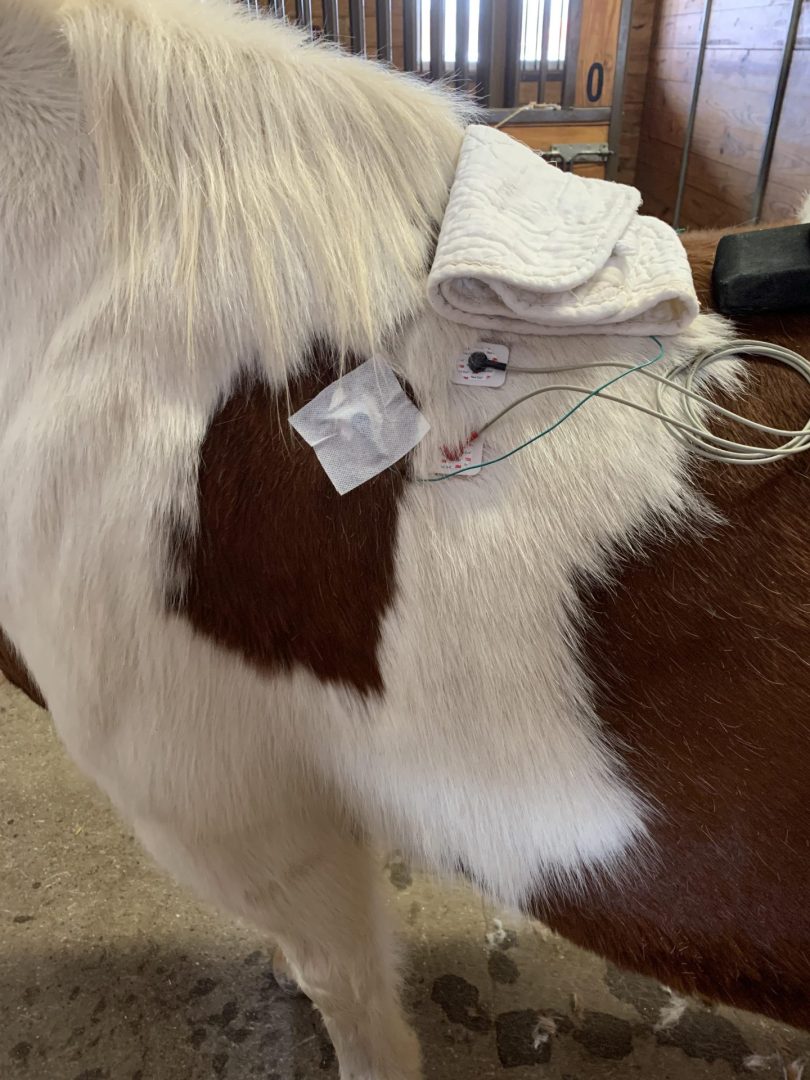
Cardea SOLO device in place.

The Cardea SOLO electrode is covered with sticky tape (Elasticon) to protect the wearable from the elements.

“The exciting part was that it worked, and it did give a good quality ECG when the horse wasn’t moving around too much.”
Dr. Sian Durward-Akhurst